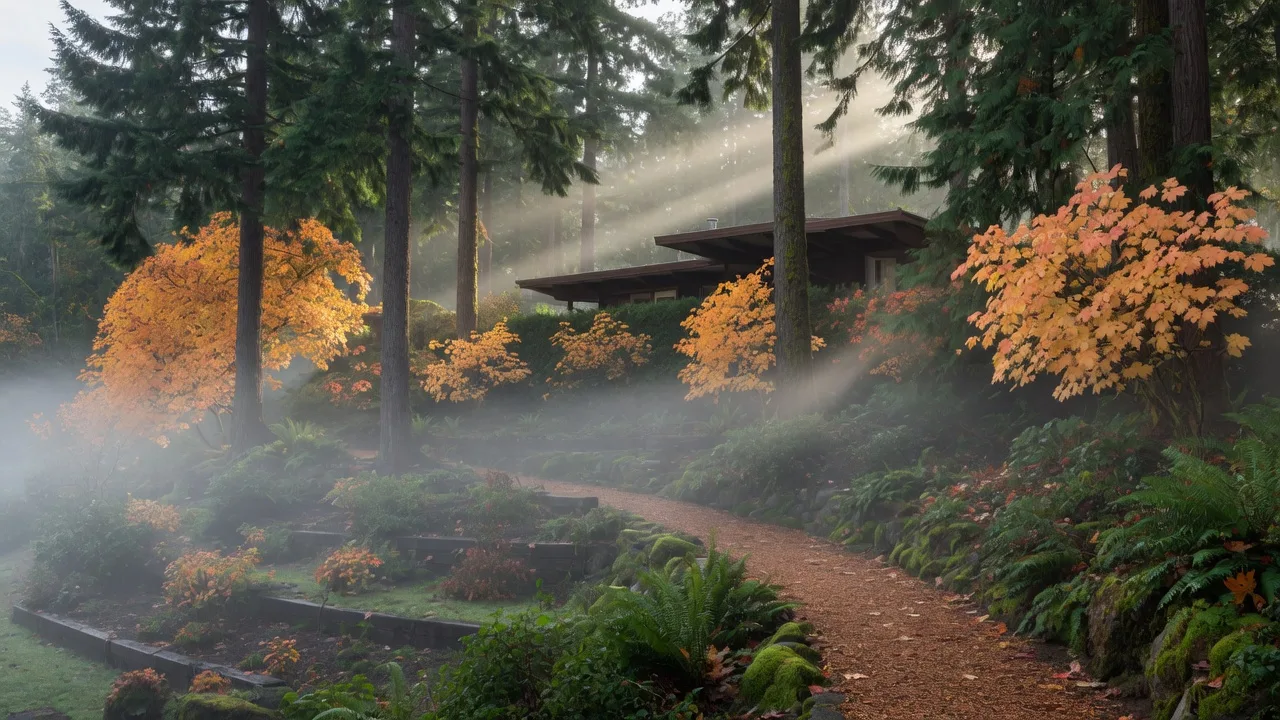
When buyers weigh a home on a forested lot, the trees are usually treated as scenery. The research says they are closer to equity. A growing body of hedonic studies, including a 2022 USDA Forest Service meta-analysis, finds that tree cover measurably raises home values, and that the effect is strongest in exactly the kind of leafy, larger-lot neighborhoods buyers find near Tryon Creek State Natural Area. Here is what the data says, and what you should actually check before buying a treed acreage in the Portland area.
What the Research Says
The USDA Forest Service's 2022 meta-analysis of hedonic property studies found that the price elasticity of tree cover is roughly four times larger in neighborhoods with more than 25 percent tree cover than in sparsely treed ones, about 0.013 versus 0.003 per 1 percent of cover (Tree cover and property values in the United States, USDA Forest Service). In plain terms, the marginal tree is worth more where trees are already the character of the street, which is precisely the profile of SW Portland's forested corridors. Researchers at the University of Washington's Green Cities: Good Health program reached a similar conclusion from the builder's side: houses on wooded lots can recover conservation costs through higher prices and faster sales, and larger trees add the most value (Green Cities: Good Health, local economics). A 2023 systematic review of remote-sensing studies confirmed the pattern across cities: increasing tree canopy at the property and neighborhood level, forest size, greenness, and proximity to urban forests all increased housing prices, with the strongest effects for middle-to-high-income homes on large lots (Influence of urban forests on residential property values, systematic review).
The Protected-Park Premium
Proximity to a protected natural area compounds the tree effect because the view corridor and the green buffer are permanent. Tryon Creek State Natural Area's 645 acres sit directly across the street from 1111 SW Coronado St, which means the towering evergreens you see from the windows are part of a state park that will never be developed. That permanence is why forested lots beside protected open space are among the most durable values in the Portland market: the amenity cannot be built out, subdivided, or logged. Few parcels combine that guarantee with almost three acres of private, two-tax-lot grounds, which is why the profile is scarce wherever it appears.
What a Buyer Should Actually Check
A treed lot is an asset you manage, not an ornament you ignore. Before you close, get a certified arborist assessment of the mature trees so you know the health of the canopy and the real cost of any hazard trees; it is the single highest-value inspection on a forested property. Check your position on Oregon's Statewide Wildfire Hazard Map and any Wildland-Urban Interface designations, which tell you whether defensible-space rules apply. Under Oregon law (ORS 476.392), homes in high-hazard areas are moving toward formalized defensible space in three zones: non-combustible within 0 to 5 feet, lean and clean from 5 to 30 feet, and careful spacing from 30 to 100 feet or more (Oregon State Fire Marshal defensible space, ORS 476.392). In Portland, a permit is required to remove any private tree 12 inches DBH or larger, with inch-per-inch replacement under Title 11 (Portland tree removal and replanting permits), so budget and plan before you change the canopy. For day-to-day care, OSU Extension recommends pruning lower limbs to raise the crown while never removing more than 50 percent of the live crown, and keeping needles and leaves off the roof and out of gutters through the rainy season (OSU Extension woodland pruning guidance). Our buyer's guide to trees, gutters, and moss walks through the inspection checklist on the ground.
The Value Case at 1111 SW Coronado St
By every measure the research uses, 1111 SW Coronado St is the forested-lot profile that holds and grows: nearly 3 acres spanning two tax lots beside a protected 645-acre state park, with winding footpaths, terraced garden beds, a greenhouse, and a mid-century home that frames the evergreens from nearly every room. The trees are not just the setting, they are part of the long-term value story. Contact Danielle Bade to walk the grounds, review the property documents, and talk through what the forest means for your offer.

Danielle Bade
Principal Real Estate Broker, Bade Real Estate